Yixuan Yang
Ph.D. Student in Electrical & Computer Engineering
Duke University

About Me
Hi there from Yixuan! I am a Ph.D. student in the Department of Electrical and Computer Engineering at Duke University, advised by Professor Rishi Kamaleswaran in the Kamaleswaran Lab. My research focuses on world models and self-supervised representation learning. I study how complex dynamical systems evolve under intervention, and how to build representations of those dynamics that transfer across tasks and domains. My current setting is clinical foundation models. Prior to this, I worked in the General Robotics Lab during my first year under the supervision of Professor Boyuan Chen, exploring Contact-Rich Robotic Manipulation and Embodied AI. My long-term goal is to build foundation models that understand how the world changes: systems that learn predictive world models and make robust decisions in complex, unstructured environments 🧠🤖.
I received my Bachelor's degree in Computer Science from Southern University of Science and Technology, where I was proud to be supervised by Chair Professor Xin Yao. In the Fall 2022 semester, I studied at the University of California, Berkeley as an exchange student. Back in China, I joined Professor Xinlei Chen's research group at Tsinghua University as a visiting student.
Research interests World Models & Latent Dynamics · Self-Supervised Representation Learning · Sequential Decision-Making under Uncertainty · Embodied & Clinical Foundation Models
News
-
[Jul. 2026]
The NC Statewide AI Strategic Roadmap, which I contributed to as a Student Researcher with the North Carolina AI Leadership Council, was officially announced by Governor Josh Stein.
-
[May 2026]
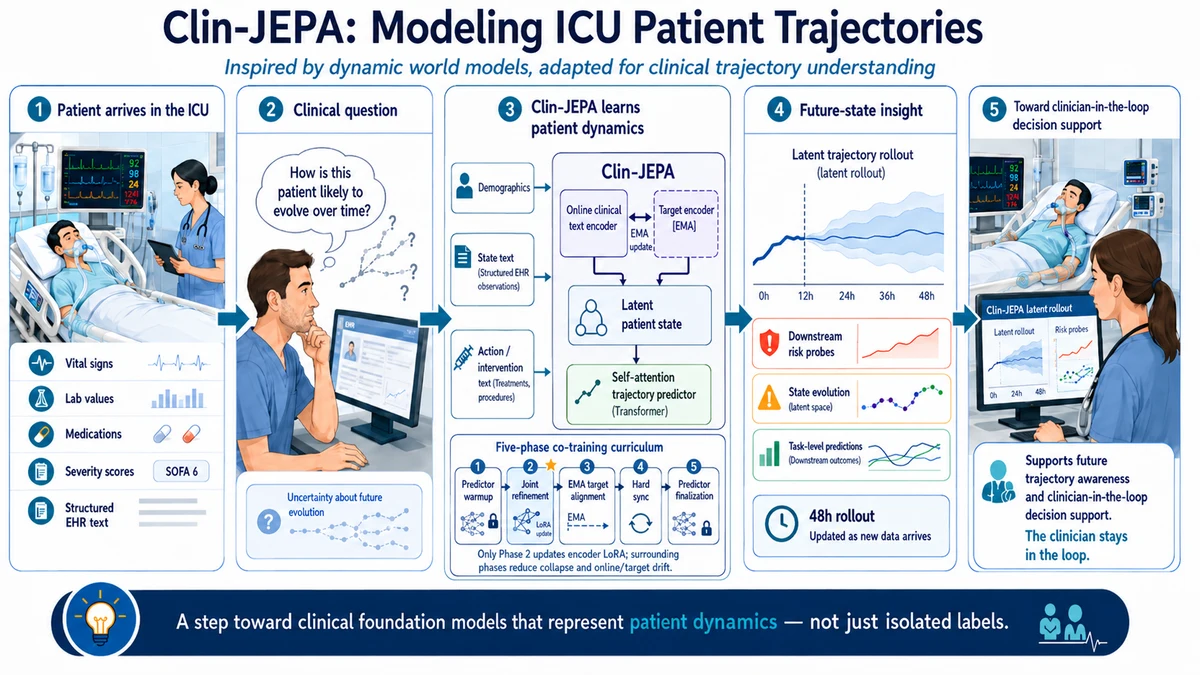
Our new preprint "Clin-JEPA: A Multi-Phase Co-Training Framework for Joint-Embedding Predictive Pretraining on EHR Patient Trajectories" is now on arXiv!
-
[Mar. 2026]
I'm glad to share that I passed my PhD qualification exam!
-
[Nov. 2025]
🎉 The paper "SniffySquad: Patchiness-Aware Gas Source Localization with Multi-Robot Collaboration" got accepted to the journal - ACM Transactions on Sensor Networks.
-
[Aug. 2025]
I joined the Kamaleswaran Lab to kick off my second year.
-
[Aug. 2024]
I officially started my Ph.D. journey in the General Robotics Lab at Duke University! 🚀
-
[May 2024]
🎉 I was awarded the Guo Xie Bi Rong Fellowship (¥10,000), Class of 2024. (only 4%)
-
[May 2024]
🎉 I was awarded as an Outstanding Undergraduate Graduate (only 25%), Class of 2024 (SUSTech), as well as a Distinguished Graduate (Top 2 out of 245 students) in the Department of Computer Science and Engineering.
-
[Mar. 2024]
🎉 The paper "Learning-Based Problem Reduction for Large-Scale Uncapacitated Facility Location Problems" got accepted to the conference CEC 2024 held in Yokohama, Japan.
-
[Dec. 2023]
🎉 The paper "Poster: Olfactory Sensing in Turbulent Airflow via Collaborative Robots" got accepted to the conference HotMobile '24 held in San Diego, United States.
-
[May 2023]
I became a visiting student in Professor Xinlei Chen's lab. I worked with several Ph.D. and MS students in the project Gas Source Localization driven by Collaborative Robots.
-
[Jan. 2023]
I joined Chair Professor Xin Yao (Fellow, IEEE)'s Lab, and started doing research in large-scale UFLP Problem.
-
[Aug. 2022]
🛫 I arrived at the United States to be an exchange student at UC Berkeley 😎. Hi California!!! (Cal's weather is soooooo fantastic!!! ☀️🥹)
-
[May 2022]
I attended the Summer Workshop 2022 in the School of Computing at National University of Singapore (NUS). We used Unity to develop a networked 2D Game.
Research Experiences
You can also check my Google Scholar profile.
-
arXiv
 Preprint: arXiv:2605.10840 (May 2026) · under review
Every JEPA before this one either discards the predictor or trains it on a frozen encoder, so the encoder never learns to support the rollout it will be asked for. Clin-JEPA co-trains them, and the representation spreads out: 55% more effective dimensions, variance no longer piled into a handful of them. Freeze that same encoder, train a predictor the ordinary way, and long-horizon accuracy falls below doing nothing.
-
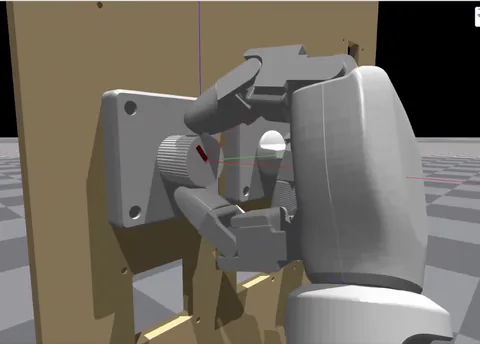
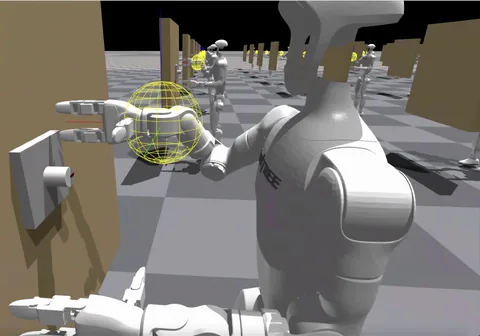
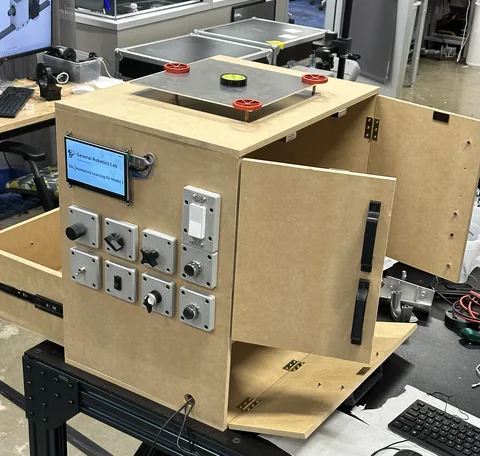 Contact-Rich Humanoid Manipulation for Scientific Laboratory AutomationGeneral Robotics Lab, Duke University (Aug. 2024 – Mar. 2025)Demos: [] [] [] [] [] []
Laboratory instruments are built for human hands: knobs, switches, small buttons. This project put a Unitree G1 humanoid in front of one, pairing a physical testbed with a dimension-matched replica in Isaac Gym. Most of the work was the task stack itself: an inverse-kinematics control interface, fingertip contact sensing, and the reward and termination design that gets PPO to learn contact-rich motion rather than flail near it.
-
ACM TOSN
 ACM Transactions on Sensor Networks (Feb 2026) (DOI: 10.1145/3786599)[Paper]
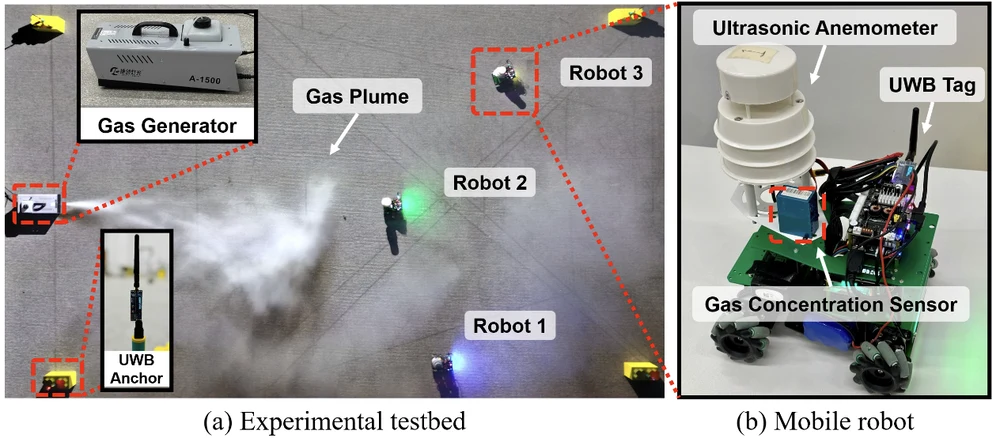
Turbulence tears a gas plume into patches, and every patch can look like the source. So SniffySquad stops climbing the gradient and starts sampling: each robot is a Langevin chain on a shared belief map, and its temperature is its role. Hot robots roam, cold robots inspect, and the two trade places by the same acceptance rule parallel tempering uses. Success rate up 20%, path efficiency up 30%.
-
HotMobileHotMobile 2024: Proceedings of the 25th International Workshop on Mobile Computing Systems and Applications[Paper]
Turbulence scatters a gas plume into patches, so following the concentration gradient walks a robot into a decoy. This early poster gives a robot team heterogeneous roles: some inspect the strongest reading found so far, others keep hunting for new candidates, and the roles are exchanged as the readings change. Search time fell 37% against Surge-Cast and 22% against Infotaxis, which gets trapped in exactly those patches.
-
IEEE CEC
 CEC 2024: IEEE Congress on Evolutionary Computation[Paper]
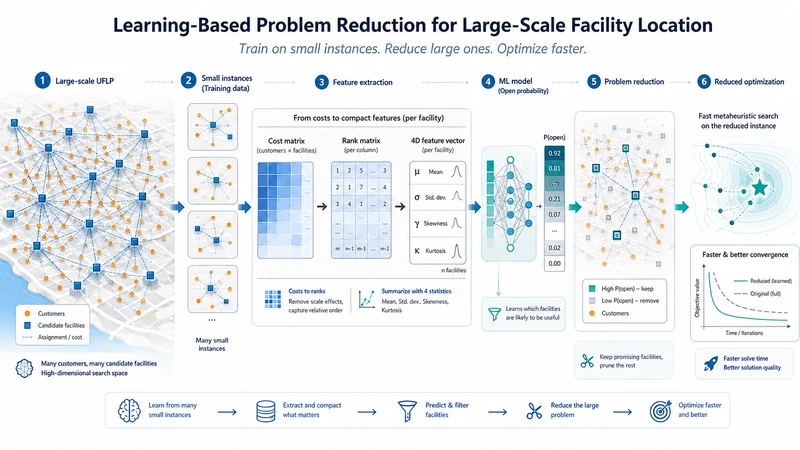
Facility location at scale defeats search heuristics, so this shrinks the problem before solving it. The trick is to look at ranks rather than costs: each facility is described by the shape of its rank distribution across customers, so the same four numbers describe it whether the instance holds fifty sites or five thousand. That scale-free footing is why a model trained on instances a solver can crack exactly transfers to ones it cannot, cutting benchmarks to 13% of their size.
-
 Final project, Duke ECE 590 / ME 555: Robot Learning (Fall 2024)
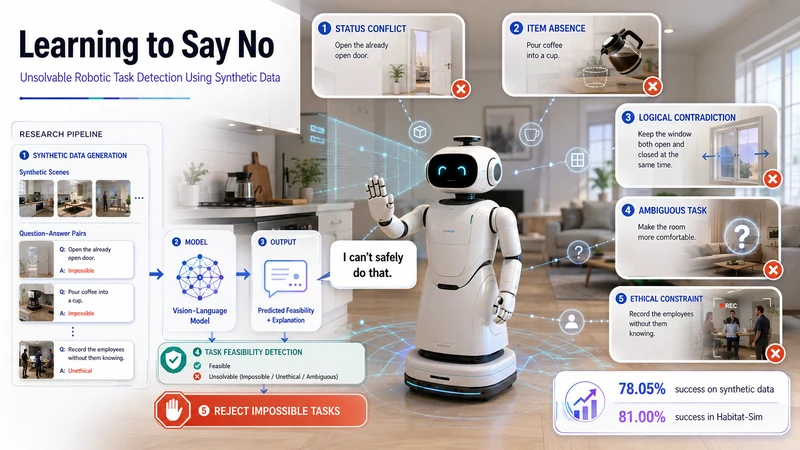
Robots asked to do something impossible tend to try anyway. This builds a synthetic dataset of five ways a task can be unsolvable, from a missing item to an ethical refusal, then fine-tunes a vision-language model to spot them and say why. Refusal accuracy goes from 10% to 78% on the generated images, and 81% in Habitat-Sim, a renderer it never trained on.